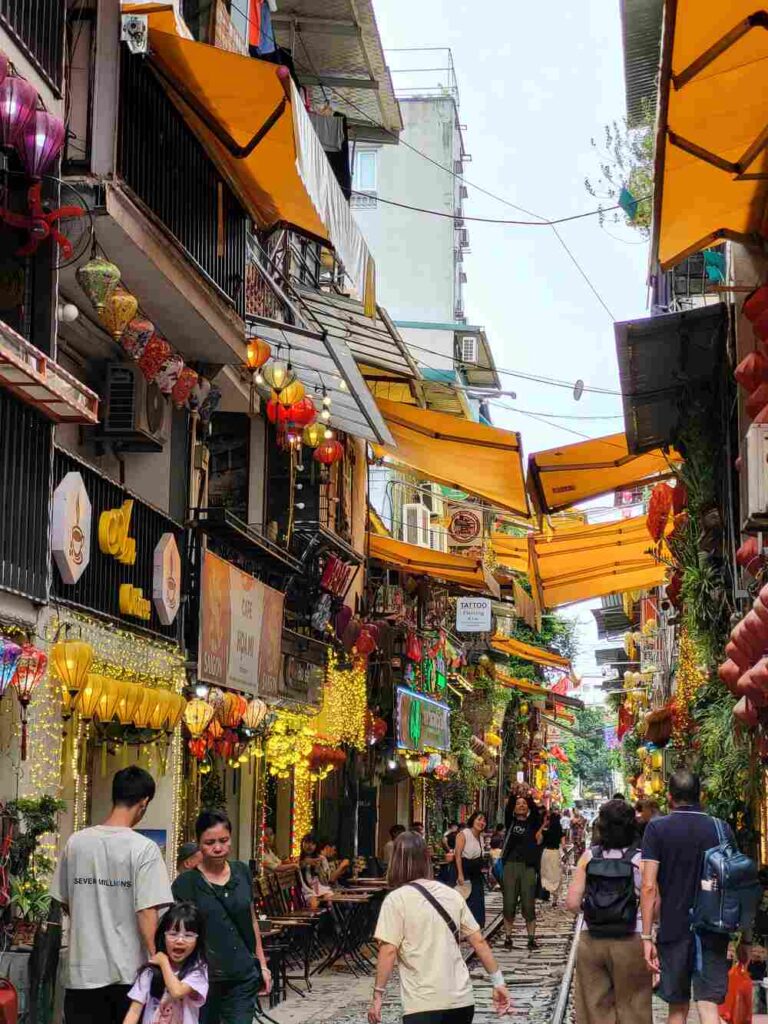
Do You Need to Speak Vietnamese Phrases to Travel in Vietnam?
Many people ask if you need to know Vietnamese to travel to Vietnam. The short answer to that is: no.
You don’t have to speak Vietnamese to travel in Vietnam, but learning basic Vietnamese phrases helps you connect with locals. Most people in tourist spots like Hanoi, Ho Chi Min, Da Nang (etc) speak some English, but speaking the local language shows respect and often leads to friendlier experiences.

Having experienced this incredible country myself, I can tell you firsthand that the experience becomes even more meaningful when you can connect with locals through their language. It’s a gateway to deeper conversations, sweet moments, and a better understanding of Vietnam’s beauty.
Learning some basic Vietnamese phrases can really better your experience. Even a simple “Xin chào” or “Cảm ơn” can light up a local’s face in a way that no amount of pointing at a menu ever will. Whether you’re bargaining at a night market or ordering pho from a street vendor, a handful of well-placed Vietnamese phrases goes a very long way.
Many people in the major cities speak basic English for tourism, but no matter where your Vietnam itinerary takes you, it’s always good to have a few words under your belt for easier communication.
Visit Vietnam’s official Tourism page for ideas of what to do while visiting.
Quick History of the Vietnamese Language
The Vietnamese language has a rich history rooted in the Austroasiatic language family. Vietnamese was shaped by various cultural and historical influences, notably the Chinese during their thousand-year rule starting in 111 BCE.
In the 19th century, French colonial rule brought further changes with the introduction of the Latin-based Quốc Ngữ script.
Post-independence, Vietnamese continued to evolve and is now the official language of Vietnam, spoken by the majority of the population. The language’s global presence has also grown through the Vietnamese diaspora in countries like the United States, Australia, and France. Despite these external influences, Vietnamese has maintained its distinct linguistic identity.
Useful Vietnamese Phrases to Know
It’s always a nice touch to learn some essential Vietnamese phrases when going to Vietnam. Every traveler should know some common language skills for the country they’re traveling to. From ordering street food, asking for directions, or just saying “hello,” these basic Vietnamese phrases will help you in daily conversation.
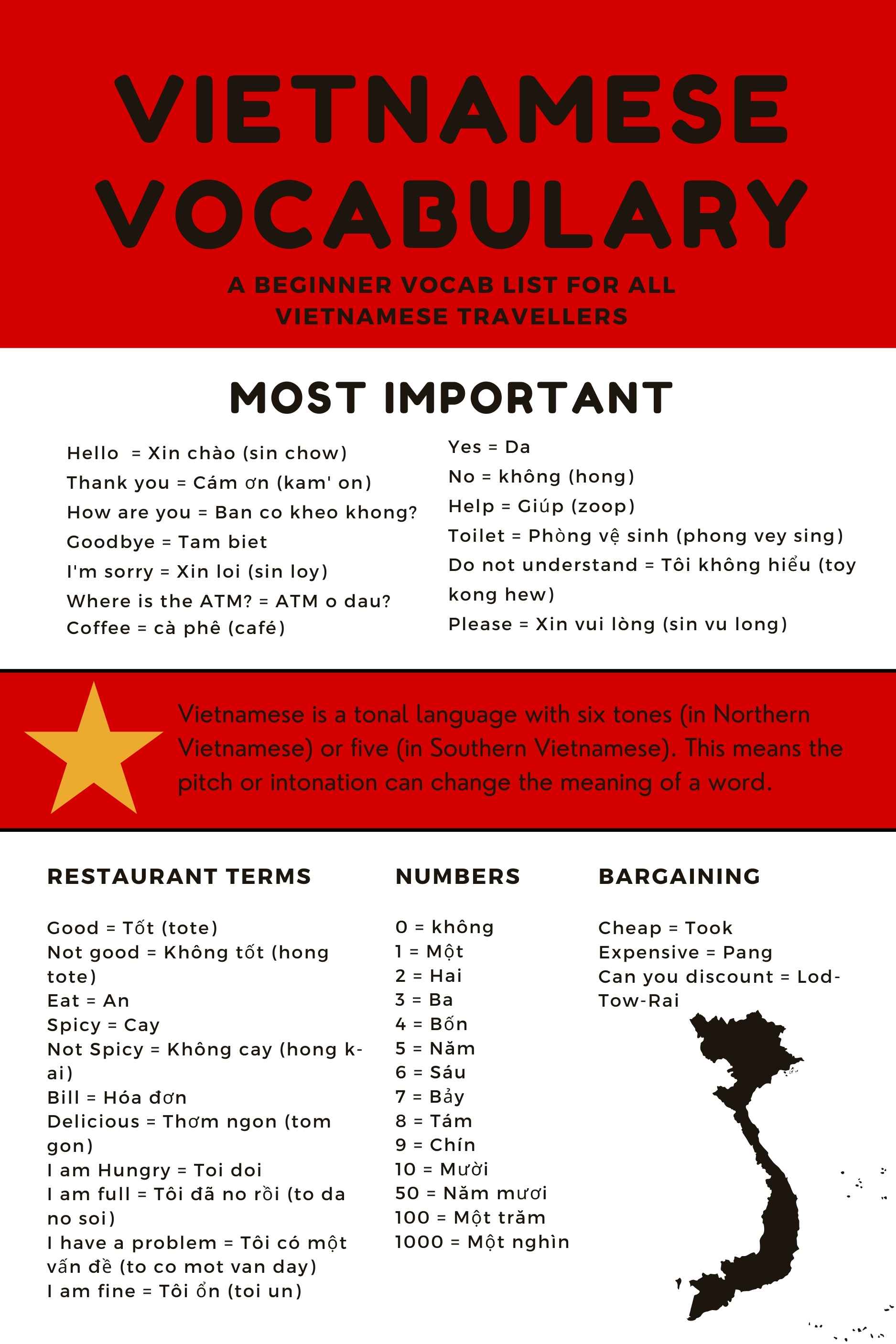
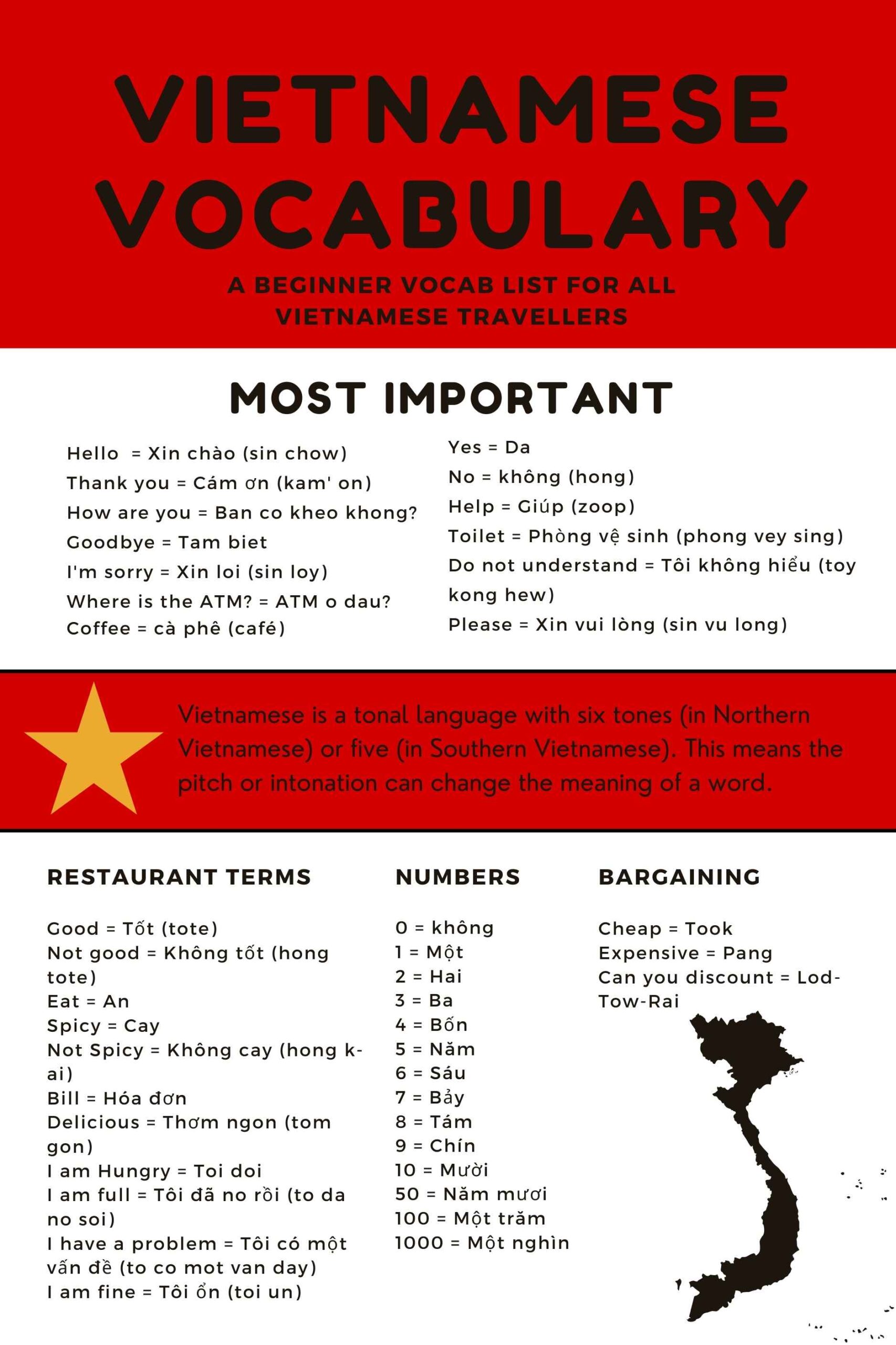
PDF of Vietnamese Cheatsheet
I have included a PDF of a table that includes all of the following phrases below. Feel free to save it or print it out to bring it on your journey!
Useful Vietnamese Phrases to Know
It’s always a nice touch to learn some essential Vietnamese phrases when going to Vietnam. Every traveler should know some common language skills for the country they are traveling to.
From ordering street food, asking for directions, or just saying “hello,” these basic Vietnamese phrases will help you connect with locals in daily conversation and make your trip unforgettable.
The Basics
This is a small list of the most useful phrases to know in Vietnamese. Start here if you’re short on time!
| English | Vietnamese | Pronunciation |
|---|---|---|
| Hello | Xin chào | sin chow |
| Thank you | Cảm ơn | gam on |
| How are you? | Bạn có khỏe không? | ban co kweh hong |
| Goodbye | Tạm biệt | tam biet |
| I’m sorry / Excuse me | Xin lỗi | sin loi |
| Please | Xin vui lòng | sin vu laow |
| Yes | Dạ | da |
| No | Không | hong |
| Help | Giúp | zoop |
| Toilet | Phòng vệ sinh | phong vey sing |
| I don’t understand | Tôi không hiểu | toy kong hew |
| Coffee | Cà phê | café |
| Where is the ATM? | ATM ở đâu? | ATM uh dow |
| How much does this cost? | Cái này bao nhiêu? | kai nay bow nyew |
| I need a doctor | Tôi cần bác sĩ | toy can bak see |
Restaurant Phrases
Vietnam has freaking amazing food! Each region has its own specialties, and the sheer tastiness of every dish was just….yum. Even the street vendors blew me away with the bánh mì and pho. Here are some basic Vietnamese words to use when ordering or complimenting food on your trip.
| English | Vietnamese | Pronunciation |
|---|---|---|
| Good | Tốt | tote |
| Not good | Không tốt | hong tote |
| Eat | Ăn | an |
| Spicy | Cay | k-ai |
| Not spicy | Không cay | hong k-ai |
| Bill / Check | Hóa đơn | hwah dun |
| Delicious | Thơm ngon | tom gon |
| I am hungry | Tôi đói | toy doi |
| I am full | Tôi đã no rồi | to da no soi |
| I have a problem | Tôi có một vấn đề | to co mot van day |
| I am fine | Tôi ổn | toi un |
| Water please | Cho tôi nước | cho toy nuoc |
| No meat please | Không có thịt | hong co tit |
| Vegetarian | Ăn chay | an chay |
Bargaining Phrases
Shopping and bargaining are expected in Southeast Asia, especially in Vietnam. If it’s your first time traveling to a bargain-heavy culture, knowing some common Vietnamese phrases can take you a long way.
Knowing how to bargain in local markets and shops is a trained skill, and the people will definitely put you to the test!
| English | Vietnamese | Pronunciation |
|---|---|---|
| Cheap | Rẻ | zay |
| Lower | Thấp hơn | top hun |
| Too expensive | Quá nhiều tiền | qua no tien |
| I want | Tôi muốn | toy mwuhn |
| Can you lower the price? | Bớt giá được không? | bot za duoc hong |
| I’ll pay this much | Tôi trả bao nhiêu | toy tra bow nyew |
| Good price | Giá tốt | za tote |
Numbers
Knowing your numbers is incredibly useful for bargaining, ordering quantities, and understanding prices!
| Number | Vietnamese | Pronunciation |
|---|---|---|
| 0 | Không | hong |
| 1 | Một | mot |
| 2 | Hai | hi |
| 3 | Ba | ba |
| 4 | Bốn | bone |
| 5 | Năm | nam |
| 6 | Sáu | sau |
| 7 | Bảy | bay |
| 8 | Tám | tam |
| 9 | Chín | chin |
| 10 | Mười | moi |
| 50 | Năm mươi | nam moi |
| 100 | Một trăm | mot tam |
| 1,000 | Một nghìn | mot neen |
| 10,000 | Mười nghìn | moi neen |
Key Differences Between Vietnamese and English
The first thing to note about Vietnamese is how different it is from English, from pronunciation to grammar. Vietnamese uses the same alphabet as English; however, there are a few fundamental differences that are important for learning, understanding, and speaking it confidently.
Vietnamese is a Tonal Language
Vietnamese is a tonal language with six tones (in Northern Vietnam) or five (in Southern Vietnam). This means the pitch or intonation can change the meaning of a word. For example, “ma” can mean “ghost,” “mother,” or “rice seedling,” depending on the tone.
The Key to Vietnamese Pronunciation
The Vietnamese language has many sounds not found in English, such as “ng” at the beginning of a word (like “người” for “person”). It also uses a lot of diacritical marks, which are critical for pronunciation and meaning.
Vietnamese Grammar
Vietnamese does not have verb conjugations or plural forms. Instead, context and word order play a significant role. Additionally, there’s no distinction between masculine and feminine forms.
Word Order in Vietnamese
Vietnamese follows a Subject-Verb-Object word order, similar to English.
How to Pronounce Vietnamese: Tips for Travelers
Vietnamese pronunciation is challenging for many travelers, but a few simple tips make things much easier:
- Focus on the tones first. The same word can have wildly different meanings depending on the pitch, so tune your ear before anything else.
- Practice words that start with “ng” (like “người” meaning “person”) , this sound doesn’t exist at the start of English words, but it’s very common in Vietnamese.
- Don’t stress over silent letters. Many letters in Vietnamese are pronounced roughly as written, so lean into what you see.
- Listen to native speakers. Even playing YouTube videos or phrase podcasts while you’re packing is useful for adjusting your ear.
- Think musically. Vietnamese has a rising and falling “musical” quality to it , paying attention to that overall melody is often more important than perfecting every syllable.
Most importantly: don’t be afraid to smile and try, even if you make mistakes. Locals will almost always appreciate the effort, and that’s what really matters.
Famous Vietnamese Sayings and Proverbs
Vietnamese has a lot of colorful expressions and proverbs that reveal a lot about the culture’s values.
One famous saying is “Ăn quả nhớ kẻ trồng cây“, literally, “When eating fruit, remember who planted the tree.” This phrase is used to promote gratitude and remind people not to forget those who have helped them. It’s a beautiful sentiment, and one that actually feels very true to the warmth I experienced from Vietnamese people during my travels.
Another classic is “Có công mài sắt, có ngày nên kim“ which translates to “With effort, iron will become a needle.” It’s the Vietnamese way of saying that dedication and hard work eventually pay off.
Vietnamese Slang and Modern Phrases
Slang is just fun to know in all languages.
- “Zui” – a playful, informal way of writing “vui,” meaning “fun.” You’ll see this pop up in texts and comments online.
- “Like” – borrowed directly from English and used in exactly the same way, especially among younger crowds.
- “Ông trời” – literally “the sky king,” used to mean “fate” or “destiny,” and sometimes used humorously when things go unexpectedly.
- “Đỉnh” – means “awesome!” and you’ll hear it a lot when something is really impressive.
Slang changes quickly, but even knowing a little makes you cooler than others.
Download and Use Vietnamese Phrase Guides (PDF)
For convenient on-the-go use, I’ve included a printable PDF cheat sheet of all the phrases in this post (it’s free, don’t worry). Feel free to save it to your phone or print it out to keep in your wallet or daypack!
Beyond that, it’s worth searching for audio resources online. Phrases are one thing to read, but hearing the correct tones spoken by a native speaker is a completely different, and much more useful, experience.
Tips for Learning Vietnamese Before Your Trip
Tips for learning Vietnamese are much the same as learning any other language, but here are a few I can pass on from personal experience:
Start with common phrases.
Begin with simple Vietnamese phrases that you’ll use often (like ones in this post!). This helps you get accustomed to the rhythm and tone of the language.
Use visual aids
Flashcards with both the word and its tone mark can help reinforce correct pronunciation. I also enjoy having phrases written out phonetically in English so I can sound them out without overthinking it.
Immerse yourself
Listening to Vietnamese music, watching movies, or trying to speak with native Vietnamese speakers is one of the most effective methods of learning. Immersion is genuinely one of the best ways to pick up the nuances.
Learn basic grammar
While grammar isn’t as complex as some languages, understanding sentence structure and word order will help you form your own sentences more naturally.
Practice regularly
Consistency is crucial. Practice a little every day, whether through apps, language partners, or just speaking to yourself in the mirror.
Be patient and persistent
Learning a new language takes time, especially one as different from English as Vietnamese. Stay motivated by setting small, achievable goals; even just mastering three new phrases a day adds up fast.
Key Takeaways
- Vietnamese uses six tones in the north (and five in the south); tone is everything when it comes to meaning.
- Basic phrases help you have a far more authentic travel experience, even in tourist-heavy areas.
- Famous Vietnamese sayings and proverbs deepen your cultural connection and make a great impression on locals.
- Pronunciation guides and audio resources are especially helpful for getting those tonal sounds right.
- Downloadable phrase PDFs are a simple, practical way to boost your learning and keep phrases handy on the road.
- Learning a little slang helps you connect with younger locals in a genuinely fun way.
- English works well in most tourist areas, but even basic Vietnamese phrases win big smiles.
- Practice daily for fast and noticeable progress.
Conclusion
Even knowing just a few of these most basic Vietnamese phrases can make a huge difference when conversing with Vietnamese locals or just navigating the country. I hope this is useful on your next adventure and these key phrases help with an unforgettable experience to come. Enjoy your travels.
Frequently Asked Questions
What does Chi Oi mean in Vietnamese?
Chi Oi (Chị ơi) is a respectful way to address an older woman, similar to saying “Miss” or “Ma’am” in English. It’s commonly used to politely get someone’s attention, for example, calling over a waitress or asking a woman on the street for directions. It’s one of those small phrases that shows cultural awareness and goes a long way toward making a good impression.
Is it necessary to speak Vietnamese to get by in big cities?
No, it is not necessary to speak Vietnamese to get around in major cities like Hanoi or Ho Chi Minh City. In tourist areas, most people working in hospitality, restaurants, and shops speak at least some English. That said, knowing even a handful of basic Vietnamese phrases is still genuinely helpful, especially once you venture off the main tourist trail, and it’s almost always met with warmth and enthusiasm from locals. Think of it less as a necessity and more as one of the best investments you can make in your overall travel experience.
Similar Posts
If you are still in the planning phases of your trip, I have a Vietnam city-by-city guide of all the popular Vietnamese destinations, with what to do and where to eat in each place!
I also wrote a post about my Vietnam travel budget and what to expect to spend on your trip, depending on your travel style.